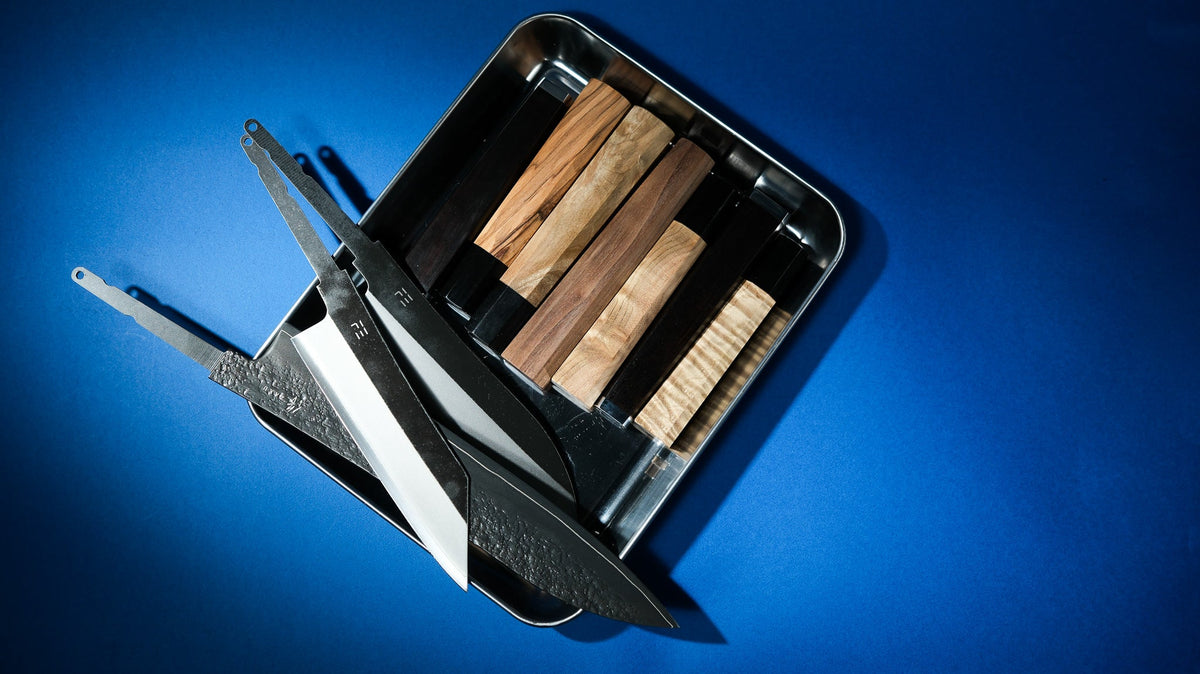
FE lets people build the knife they will use every day: they choose the blade and the handle, and they can see it being assembled in-store. We spoke with Stefan Kitanovikj, the creative director and brand designer behind FE, about fine art, cross-border craft, and why a knife brand chose facts over storytelling.
You trained as a fine artist, not a knifemaker. How did that path lead you to FE?
My background is in fine arts. I'm a classically trained visual artist. Over time, I felt that art didn't answer my need to connect with people, while design is something people use every day. So I moved into fashion. Clothes are about as close to people as anything can be, and I wanted to design things people live with daily. From fashion I moved into product design, and today I work as a creative director. I've lived and studied in Japan, and I specialize in traditional Japanese crafts. There is so much beautiful knowledge in these crafts, and I wanted to find a way to share it with the world. FE grew out of that, and I designed the brand myself, from the logo to the store graphics.

Before FE had a name or a visual identity, what problems did you set out to solve?
Everything I make starts with solving a problem for the customer. Before FE existed, I noticed that across Japanese knife brands, customers were left out of creating the tool they would use it every day. With FE, I wanted to let people create that tool themselves. That's why FE is the first brand in the world that lets customers fully customize both the blade and the handle. The second problem was that knife culture around the world is very landlocked. While doing my research, I realized that the best design comes from exchanging knowledge across borders. So with FE, we work with knife specialists in other countries to bring the
customer the best-designed knife possible.
You have spent time face to face with the people buying the knives. What did they teach you that a design meeting never could?
A lot. In art and design, we usually sit in the atelier , working from our assumptions about what a customer wants. Being out front and actually learning what people want is far more rewarding, and far more important. It isn't about knowing aesthetics or giving good references. It's about solving a specific problem.
Many brands focus on creating an experience: a story , a link to a specific culture or a specific period. That isn't enough. What customers taught me is what they really need: a very good product. So FE was deliberately built without that layer , with no emotional packaging and no story wrapped around it. It is grounded in tradition and research, but the point is simply the product.

At FE, customers build their knife instead of picking one off a shelf. Why does taking part matter?
A knife is a tool you might use every day for the next twenty years. You can own a product for that long and still not understand it. But when you choose your own knife, you consider which metal and which wood to use, and in the process you learn about your tool. Throughout history , people made their own tools. Today everything is ready-made, straight off the shelf. We wanted to go back to something fundamentally human:
preparing your own food, and making the tool you prepare it with.
In FE stores, people can watch their knives being assembled. What about the way knives are usually sold did you want to open up?
I worked for another Japanese knife brand before FE, so I saw this up close. So much knowledge about traditional crafts, in Japan and in the place I come from, is locked away in a village nobody can reach, in a language most people don't speak. I wanted an exchange. I wanted people to see. That's why , in our stores, you can watch your knife being put together. Transparency matters because people carry a lot of assumptions. Craftsmen are craftsmen, and we respect them. But we live in a world where all this information is accessible. Mystifying something as simple as how a knife is made just doesn't hold up, especially in the age of AI.
You call FE contemporary, not modern. What is the difference?
People often think of tradition as something that stopped at a certain point, put in a box and labelled "traditional craft”. But who decided that? Tradition evolves with people. We don't build cars the way we did twenty years ago. Things change with the way we live. So FE isn't about being modern. Modern is already old. Contemporary is the word, because contemporary keeps moving with the people who use it.

FE is named after iron, not a place or a master craftsman, and it avoids the usual language of heritage and luxury. What did you want to communicate instead?
Simplicity . Fe is iron, element 26, and every knife is made with iron, wherever in the world it comes from. That is the whole brand: one element, every blade. We wanted FE to be international and open, a bridge between German, Japanese, Chinese, and Middle Eastern knifemaking, so we could create a tradition and a luxury of our own. When tradition is attached to a product, it often turns into a kind of luxury most people
can't take part in.
Yes, these products take time to make. But by exchanging knowledge, we can make them accessible, so people can be part of a new tradition and a new kind of luxury: contemporary custom.
Which part of FE feels the most personal to you?
The logo, because I designed it myself. It is two letters built from a few straight bars, each one cut at an angle, the way a blade is cut. Nothing else. I don't want customers to sit through long explanations or convoluted concepts. Deep down, I'm a very simple man. At the end of the day , this is a knife, a tool you use every day, and I want people to experience it in the simplest way. When I got the brief for an international brand bringing together different skills, I thought about who I am: a foreigner who lives and designs in Japan, and works with craftsmen in Japan, Germany, and China. A logo for that brand couldn't belong to one country . So no calligraphy, no crest, no craftsman's signature. Just the symbol for iron, which reads the
same in every language.

You built FE's visual identity yourself. What rules did you set?
Very few, and that is the point. One element. One blue. Line drawings instead of mood photography. Numbers and measurements instead of adjectives. English and Japanese side by side. Whether it's the website, a poster, a film, or a shop window in Kyoto, it should looks like it came from the same technical drawing.
Our philosophy is three ideas, and the identity has to carry all three: global knowledge, convergence and divergence, and continuous evolution. Knowledge from around the world converges on one element, iron, and from there it opens out into your knife. And it is never finished. Measured, refined, then measured again.
Robots, wireframes, and data are an unusual visual world for a knife brand. Why does FE embrace robotics and AI?

Which idea for FE sounded great in theory and proved hardest to make real? What did it teach you?
The customization. In theory, of course, it sounded amazing: you come into a store, look through the options, choose a blade and a handle, and your knife is ready in just 30 minutes. Nobody had done it, and I really wanted to give that to customers. But we weren't sure people would actually do it. Making it real was another matter. Joining a handle to a blade requires chemicals and machinery, and running all of that inside a store is a serious operational challenge. What I learned is that the concept matters. When you believe in a concept deeply , and it closes a real gap for customers, it pays off. If you believe in it, your stakeholders and your
customers will believe in it too.
When someone meets FE for the first time, what should they understand in the first five minutes, and what do you hope they discover later?
In the first five minutes, I want them to enter a world where facts matter more than emotions. Whether they walk into a store or open the website, I want them transported into a world without national borders, a world of technology . We live in a globalized society , and people should experience an international brand at every step. Later, I hope they realize they are simply getting a quality product. We did the work and the research, and they get to enjoy the result. And honestly, I want people to have a cool experience in our stores and online. FE is about world-building: imagining tools shared across borders that meet the needs of every contemporary person.
What makes a good knife to you, and has FE changed your answer?
Surprisingly, I don't cook for myself. That's why we have talented product designers, and I put a lot of trust in their expertise. What FE taught me is that a personalized knife is probably the best knife you can have, because it is your choice and your decision.

FE is still young. What are you most excited to work on next?
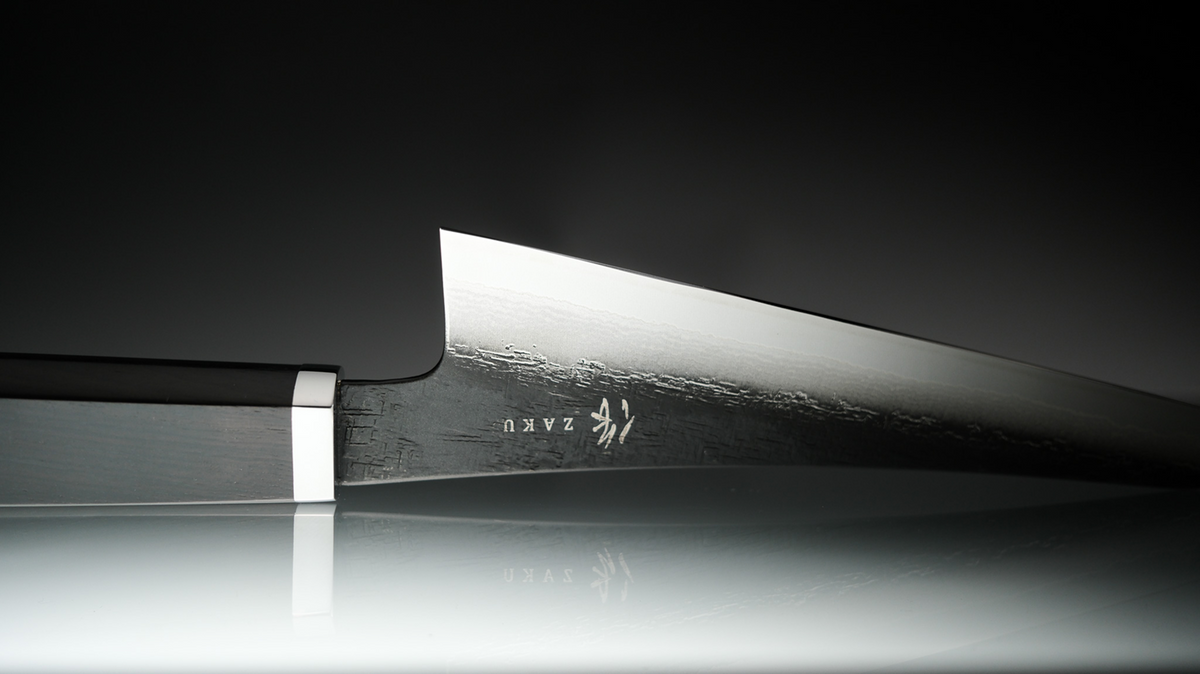
We're trying to make the most contemporary product for our customers, and the possibilities are endless. There is so much knowledge out there, not only in knifemaking but in metallurgy and the development of new steels. Our ZAKU blades already take their surface from meteorites, so I'm exploring where we can go with metallurgy , technology, and handles, because a lot of knives simply aren't comfortable to hold.
I also want to expand what people can personalize. If technology allows, I'd love to let people choose the pattern on their blade, or how the knife fits their grip. Right now we offer handles in different sizes. What we're developing is a system that lets customers scan their hands in our stores. Based on the size of their hand and how they use a knife, we'll translate that into their perfectly personalized product.