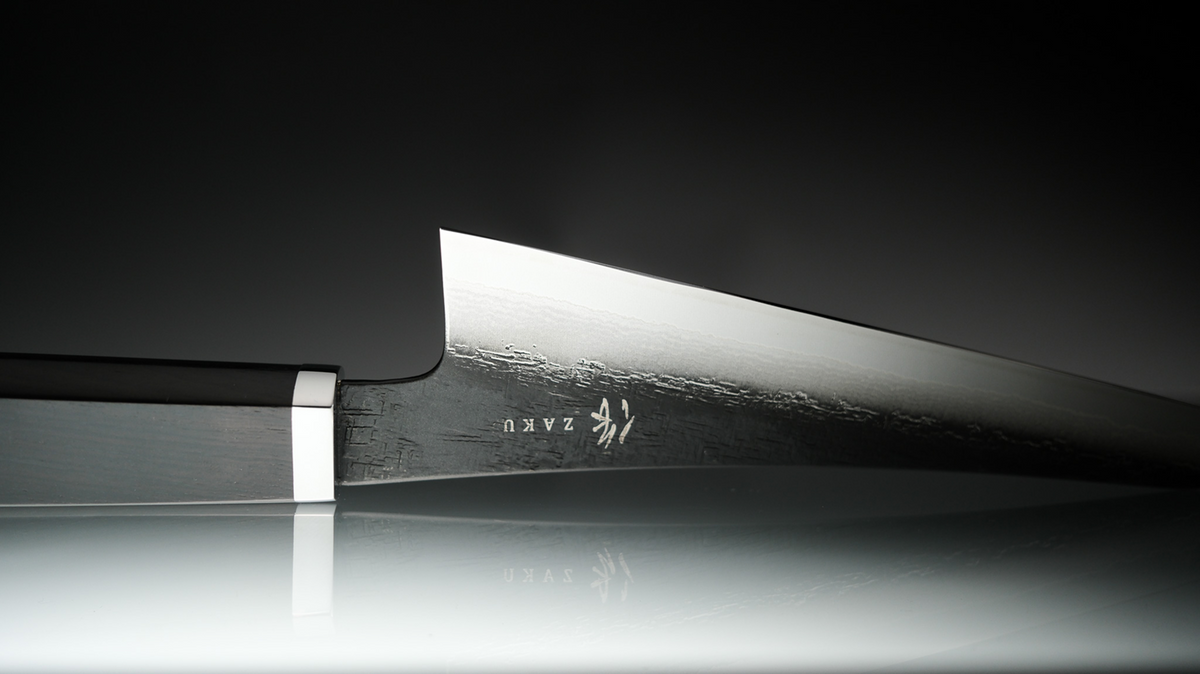
Put three Santoku knives side by side. Same shape, same length, same task in the kitchen. Yet one is matte black with a bright cutting edge, another has a fine pear-skin texture, and the third has flowing silver lines. You would never mistake one for another.
In this article, we walk you through the knife finishes we have at FE, their main characteristics, and how they differ, so it is easier for you to pick.
What Is Kurouchi? How the Makers Get That Black, Stunning Look

Kurouchi (黒打ち) means “black forged”. It is the dark, rough-looking surface you see on a knife that has not been polished all over. Here is where the black comes from. Traditionally, the steel is forged and heat-treated, and its surface reacts with oxygen and forms a dark oxide layer called forge scale. Most makers grind it away. With kurouchi, makers leave it, usually on the upper part of the blade, and grind only the cutting edge bright.
Heating and forging are not the only way to get this look. In lacquered kurouchi, the forge scale is sealed with a food-safe lacquer. Another way is black oxide or an acid bath, where a darkened finish is applied during production. These give the look of kurouchi, but they are more through forging and heat-treatment.
Kurouchi is mostly visual and traditional, and its practical effects are modest. The steel, the geometry, and the heat treatment matter far more to how a knife cuts. Some people prefer the character and old, traditional feel of kurouchi, while others want a cleaner look.
Perks of Kurouchi Finish
Some rust protection: The kurouchi finish gives the steel a little protection from rust, but not complete protection. The edge still needs care, especially on carbon steel blades.
Aesthetic appeal: The kurouchi finish is highly valued for its look. It carries the feel of traditional Japanese knife-making and gives each knife an artisanal character, which appeals to anyone who appreciates the beauty in a working tool.
Hides everyday marks: The matte, textured surface shows fewer scratches, so the knife looks good even with frequent use.
Explore the Kurouchi Collection at FE
What Is Damascus? Beautiful, Wavy Pattern Explained

A Damascus finish comes from a blade made of several steels that are layered, folded, and forge-welded together. An acid etch then brings out the flowing pattern, which can look like water or wood grain.
The acid attacks layers of different composition differently. Where nickel is used, it stays bright while the steel layers turn darker.
On Japanese kitchen knives, Damascus is usually cladding. A hard core steel does the cutting, and the patterned layers wrap around it and stop at the bevel. Those outer layers help protect a hard core from side impact.
At FE, nickel took a great deal of time and experimentation to get right. Beyond its effect on an alloy’s properties, nickel creates a very distinctive visual contrast in laminated steels and Damascus structures. That is why we began working with nickel-containing materials and nickel Damascus techniques as part of FE’s product system.
Perks of Damascus Finish
Visual depth: The layered pattern gives each blade its own character.
Protection for the core: Softer outer layers help shield a hard core steel from side impact.
A record of the work: The pattern reflects how the layers were welded, folded, and shaped.
Making a Damascus blade takes more time and skill, which is why it usually costs more. The pattern itself does not make a knife sharper, but if you value the craft and the look, it is a knife you will enjoy every time you pick it up.
Explore the Damascus Collection at FE:
What Is Nashiji? How the Pear-Skin Texture Is Made

Nashiji (梨地) means “pear skin”. The finish resembles a speckled, slightly rough surface that mimics the tiny dots and micro-grain of a Japanese pear (Nashi).
There is no single way to make it, and the texture varies from maker to maker, even from knife to knife. Most descriptions point to light hammering or stippling of the blade surface, by hand or by tool. The blade is then polished so the peaks smooth out and the valleys stay. Some makers describe fine blasting or acid etching instead. The texture typically covers the upper part of the blade face, while the cutting edge is polished.
Nashiji sits between two other looks. It is quieter than kurouchi and finer than hammered tsuchime, which has visible dimples. You will see it mostly on mid-range and premium clad knives, with either stainless or carbon steel cladding.
Perks of Nashiji Finish
Hides micro-scratches: The texture is more forgiving than a mirror polish under daily use.
Subtle food release: Due to the texture of the finish, slices come off the blade a bit more easily.
A quiet look: Rustic and traditional, without being flashy.
Explore the Nashiji Collection at FE
Which Finish Will You Pick?

A finish is easy to read about and much easier to judge in your hand. Want the raw, forged look? Go for the kurouchi. If you want a quiet, textured surface? Take a look at the nashiji collection. Sophisticated, layered silver lines are something that you are leaning towards? Then go for Damascus blades.
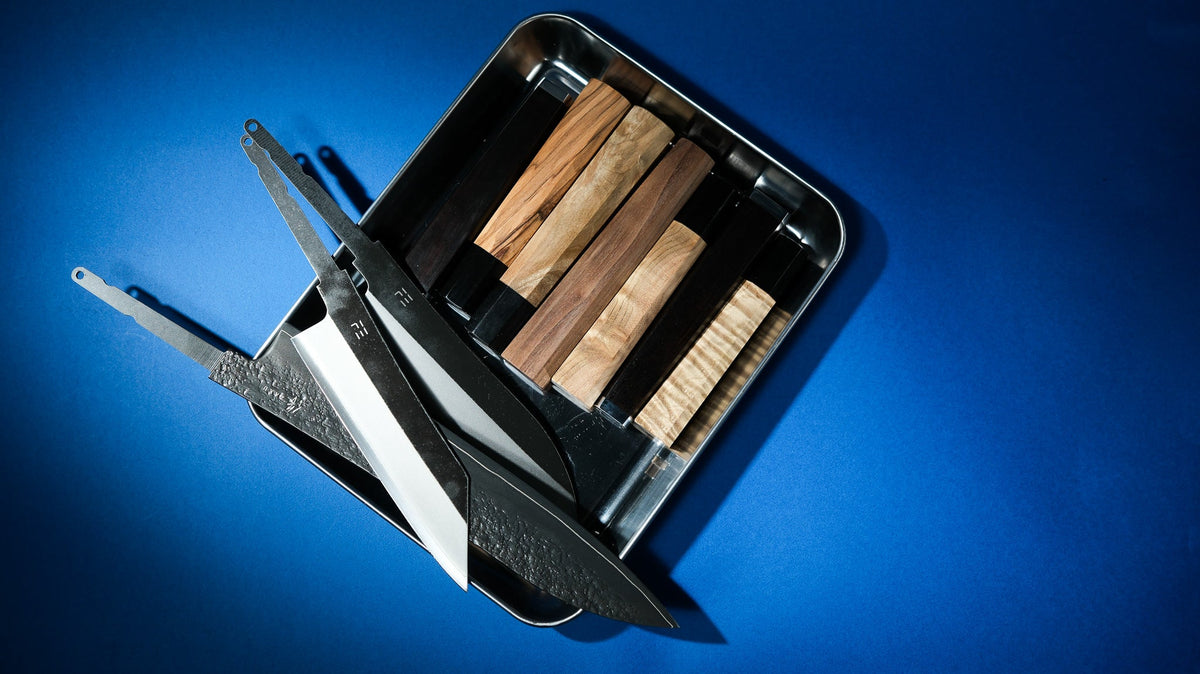
At the FE, there are not only different shapes of knives, finishes, and handles available; we are giving you the option of customizing your own tool. You can select parts of the knives that suit your needs!
Browse the full range at feproject.com, or if you are planning to visit Japan,make sure to stop by one of our stores. We are located in Osaka Namba, Kyoto Gion, or Harajuku Street in Tokyo.