Choosing a Knife Handle: Material, Feel and Balance Explained
Pick up two knives with the same blade but different handles, and your hand will tell you within seconds they aren't the same knife. One feels light and quick, while the other feels heavier and ready to go. Same steel, same edge, but a different handle will create a completely different experience.
That is the handle at work, and it is the part of a knife most people think about last. This guide walks through knife handle materials, how a handle feels, and what balance means, so you know what to look for before you choose.
Why does the handle matter as much as the blade?
The blade does the heavy work, the cutting, but the handle is where your hand feels the knife. Every slice, push, and rock goes through your hand first. If the handle fits you, the knife just turns into an extension of your own hand, and you simply navigate the whole process with ease. If it does not fit well, you notice it by the end of the prep: a tired palm, a grip you keep adjusting, an overall feeling that a knife feels slightly wrong. This is also why a handle is a very important part for you to consider. Hands differ in size, in strength, and in the way they hold a knife.

Explained: Common knife handle materials.
Handles come from a few families of materials, and each one feels different in the hand. Generally speaking, a lot of Japanese knives have wooden handles; it is a traditional and classic choice. It is warm to the touch and comfortable, and every piece has its own grain, so no two handles look exactly alike. It asks for a little care: wood does not like long soaks in water, and it benefits from a little oil from time to time. Always dry it right after washing.
If we are speaking about Western-style knives, they have a lot of different materials, such as resin, plastic, and epoxy. Synthetic materials, such as resin-based composites and plastics, resist water and stains well and stay consistent from one handle to the next. They often feel more neutral than wood, and you will find them on many knives built for heavy daily use.
Metal handles are sturdy and easy to keep clean. They also tend to be heavy, and they can feel slippery in wet hands. None of these is the best in every case. It depends on what you value most: warmth, low maintenance, weight, or looks. At FE, the handles are made from wood, and there are four options to choose from.

The four woods at FE
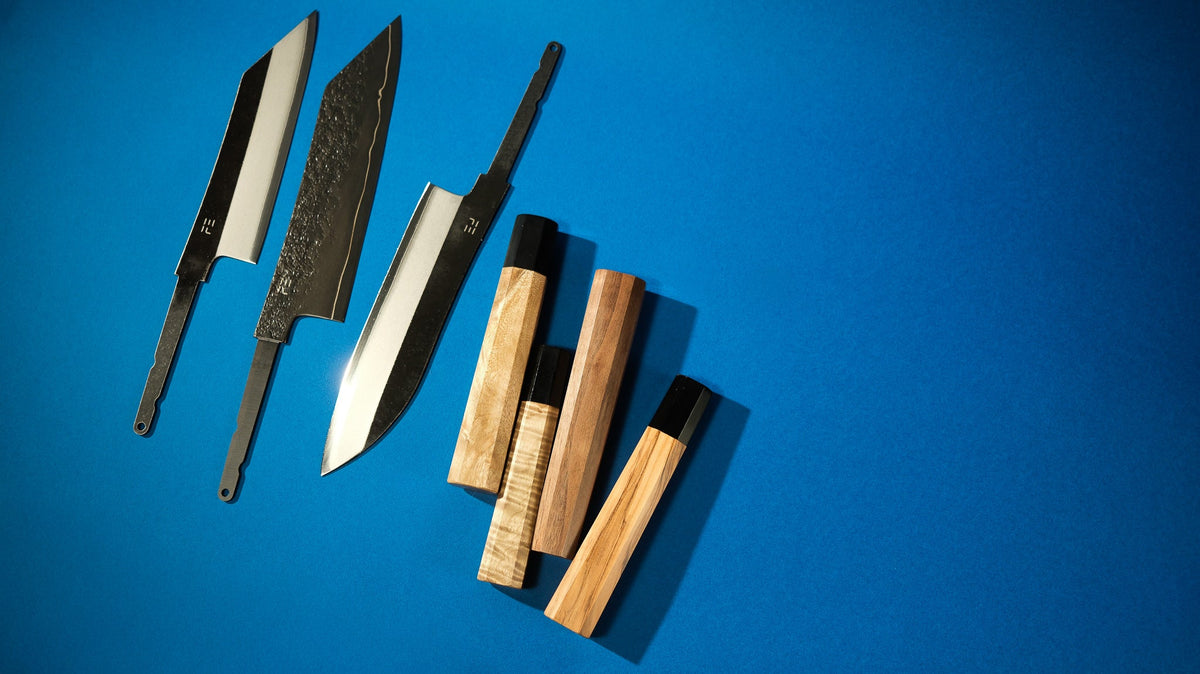
We offer Olive, Walnut, Maple, and Ebony. Each has its own look and a different weight in the hand.
Maple is minimalistic and clean, with exciting patterns. It is a hard, dense wood, and it is suitable for every kitchen.
Walnut has a rich, brown look, from soft chocolate to deeper, darker lines. It is generally a relatively lightweight wood, making it a good option for those who prefer a lighter handle.
Olive has a striking, golden-brown grain, and it is rare for two pieces to look the same. Olive is a dense hardwood, often giving the handle a more substantial feel compared with lighter woods. Every olive handle is, in a real sense, one of a kind.
Ebony is nearly black, very dense, and fine-grained, with a smooth, polished finish. In general, it is the heaviest of the four and the one that changes how a knife balances the most.
If you are torn between Maple and Walnut, the decision often comes down to color more than performance. Smooth cream or warm chocolate: pick the one you would enjoy seeing on your counter.
What does “feel” really mean?
Feel is the sum of small things. How thick is the handle compared with your hand? The shape under your fingers. Whether the surface is smooth and polished or has a little more grip from the grain. Whether the knife stays secure when your hands are wet from rinsing vegetables.
The wood shapes some of this, but size and shape matter just as much. A handle that sits perfectly in a larger hand can feel too wide in a smaller one. The feeling that you will have will tell you everything that you need to know.

What is balance, and why does a handle change it?
A knife with its balance point toward the handle may feel lighter at the tip. On the other hand, a knife with its balance point toward the blade will feel heavier toward the tip. The ideal balance depends on personal preference and how the knife is used.
The handle is half of that equation because it works as a counterweight to the blade. A dense wood like Ebony moves weight back toward your hand. A lighter wood, like walnut, leaves more of the weight in the blade. So the same blade can feel noticeably different depending on the handle you choose.
There is no single correct balance. All of us have different preferences, and the right feel also depends on what you cut.
How do you choose your handle?
Start with how you cook and how the knife feels in your hand. These are starting points, not rules.
If you like a light, quick knife for fast vegetable work, start with Walnut or Maple. If you prefer something steadier, with a little more presence in the hand, look at Olive or Ebony. If looks matter most to you, trust your eyes. A knife you truly enjoy seeing is a knife you will pick up more often.
It is also not a permanent decision. At FE, handles are interchangeable; you can replace the handle without buying a new knife.

How choosing a handle works at FE
At FE, the blade and the handle are separate choices. You pick the shape that fits how you cook, then the handle that fits your hand and your taste. We put the two together by hand, and every knife is inspected for handle fit, sharpness, and straightness before it reaches you.
If you are visiting Japan, visit one of our FE stores in person. You can hold the knives and feel the difference between blades and handles in person; we are located in Tokyo, Osaka, and Kyoto.
To understand the whole customization process, read [How to Build a Custom Kitchen Knife at FE].
Caring for a wooden handle
Wood is a natural material, so a little care goes a long way. Wipe the handle dry after washing, avoid leaving the knife soaking in the sink, and keep it out of the dishwasher.
Depending on the handle's surface finish, applying a small amount of food-safe mineral oil or camellia oil can help maintain the wood in good condition. After applying the oil, wipe off any excess with a soft cloth.
To understand the idea behind all of this, read [What is FE? A Knife Built Around Choice]. And if you are still deciding on the blade, see [Santoku vs Gyuto, or Bunka].