Japan has a long tradition of crafts and arts, from ikebana, tea, and kabuki to martial arts. Knife making is one of them. It grew out of the techniques smiths developed for samurai swords, around a thousand years ago.
As demand for swords declined during the Edo period and following the Meiji Restoration, many smiths began adapting their ancestral craft to other products. To keep working, skilled smiths applied centuries of metalworking knowledge to kitchen knives and other cutlery. This tradition continued to develop after World War II.
Today, Japanese kitchen knives are loved by home cooks and chefs around the world. In this guide, we will walk you through the knife types you will meet online or during your trip to Japan, and what to look for in a shop. It also covers where to buy and how to get your knife home safely.

Types of Japanese kitchen knives and their usage
Before the knife types, it helps to know how Japanese knives differ from the Western knives most of us grew up with.
Many Japanese kitchen knives feature relatively acute edge angles and thin blade geometries, allowing for precise and delicate cutting. However, edge angles, steel hardness, and blade construction vary widely depending on the knife's design, intended use, and manufacturer. Many traditional Western-style chef's knives feature full-tang construction and heavier handles, although blade thickness, balance, and handle design can differ considerably between products.
One term will help as you read on. A bevel is the angled surface that leads to the edge. Single-bevel knives are ground on one side only and come in right-handed and left-handed versions. Double-bevel knives are ground on both sides and suit either hand.
Most common types of steel: carbon steel vs stainless steel
Whatever shape you choose, the steel decides how the knife behaves day to day.
Most Japanese knives are made from carbon steel or stainless steel. Carbon steels, such as white (Shirogami) and blue (Aogami) steel, take a very fine edge and are easy to sharpen. They can rust if left wet, so dry them after use. White Steel contains very few impurities and is known for its ease of sharpening and ability to achieve a sharp cutting edge. On the other hand, Blue Steel, which contains added chromium and tungsten, offers excellent wear resistance, allowing it to maintain its sharpness for a longer period of time.

The most common Japanese knife types
Santoku (三徳) The name means “three virtues”, referring to the knife’s suitability for fish, meat, and vegetables. It is an all-purpose knife and a practical first Japanese knife for home cooks. Typically 160 to 180 mm, double-bevel, and widely available.
Gyuto (牛刀) The Japanese take on the Western chef’s knife. The name literally means “cow sword”, a nod to its origins as a butcher’s tool. Compared to the Santoku, the blade is longer and more pointed, with a slight curve that suits rocking cuts. Also double-bevel. Typically 210 to 240 mm.
Bunka (文化包丁) is close to the Santoku in size and use, with a reverse tanto tip that makes detailed work easier. Best suited for push-cutting and tap-chopping, the sharp tip excels at fine detailing, scoring, and working with fish or small proteins.
Nakiri (菜切り) is a vegetable knife designed for chopping, slicing, and dicing produce cleanly on a cutting board. It looks like a Usuba but has a double bevel instead of a single bevel. Typically 165 to 180 mm.
Kiritsuke (切付) is traditionally a single-bevel knife and a status symbol: only the executive chef was allowed to use it. It handles most general prep, and its distinctive K-tip allows precise, detailed work. Many modern versions are double-bevel. Typically 210 to 330 mm.
Petty (ペティナイフ) A small, versatile utility knife, typically 120 to 150 mm. It is made for small, detailed jobs such as mincing, dicing, and cutting small foods. Many cooks pair one larger knife for most tasks with a smaller one for fine work.
Below, we walk you through the more specialized knives.
Bread knife (パン切り, pankiri) A long knife with a serrated edge. It slices crusty loaves and pastries without crushing their soft insides. Typically 200 to 250 mm.
Usuba (薄刃) A thin, single-bevel knife made for cutting, peeling, and slicing vegetables with high precision. It is built for professional chefs with advanced knife skills. It cuts firm or delicate vegetables cleanly, without cracking or damaging their cell structure, and it is also used for intricate garnishing and carving. Typically 165 to 240 mm.
Deba (出刃) A traditional single-bevel knife with a heavy, thick spine, made mainly for butchering and filleting whole fish. The heel of the blade is exceptionally thick, so it can chop through fish heads and small-to-medium fish bones without damaging the edge. Sizes run from about 100 mm to 240 mm or more, and 150 to 210 mm is common.
Yanagiba (柳刃) The name means “willow-leaf blade”. It is a long, slender, single-bevel knife made for slicing boneless fish fillets into sashimi and sushi. The blade is typically 240 to 300 mm.
Honesuki (骨透き) A stiff, triangular knife built to work in tight spaces and around joints. It is mainly used for deboning and breaking down whole poultry such as chicken, duck, and turkey. The edge is often single-bevel or asymmetric, though double-bevel versions are common. Typically 135 to 165 mm, with 150 mm the most common.
Menkiri (麺切り) A specialty knife made for cutting noodles. The sobakiri and udonkiri are closely related versions. The name literally means “noodle cutter” (men is noodle, kiri is cut). The blade is wide, typically 27 cm or longer, with a completely flat, straight edge. That lets the chef slice down through folded sheets of wheat or buckwheat dough in one vertical motion, without sawing.

How to choose a Japanese knife in the shop
You do not need to be an expert; these questions will make your shopping easier.
First, what do you cook most? Is that mostly vegetables, a bit of everything, or larger cuts of meat and meals for several people?
Second, which shape? The best Japanese knife for beginners is usually a Santoku, a Gyuto, or a Bunka. If you are unsure, read [Santoku vs Gyuto vs Bunka].
Lastly, think about what handle you would like to use; for that, see our article [Choosing a Knife Handle: Material, Feel and Balance Explained].

Where to go knife shopping in Japan
Tokyo: Kappabashi. Known as Kitchen Town, this is a street of kitchenware shops, a short walk from Asakusa, where knives are a main attraction. There you can find everything: from kitchen knives to teacups.
Osaka has a number of knife shops, particularly on Dōguyasuji (道具屋筋) street in the Namba area. Like Kappabashi, it is full of restaurant supply stores, but it sits inside a covered arcade about 150 meters long.
Similar to Kappabashi, you can find a lot of commercial cookware, ceramic tableware, pottery, and of course kitchen knives.
If you would like to dive really deep into the knife topic, you should consider visiting Seki; this city is close to Nagoya. Seki is world-famous for a 700-year blade-making tradition that began with forging high-quality samurai swords during the Kamakura period. Today, the city is a global cutlery hub that utilizes those ancient smithing techniques to produce approximately 50% of Japan’s domestic kitchen knives.
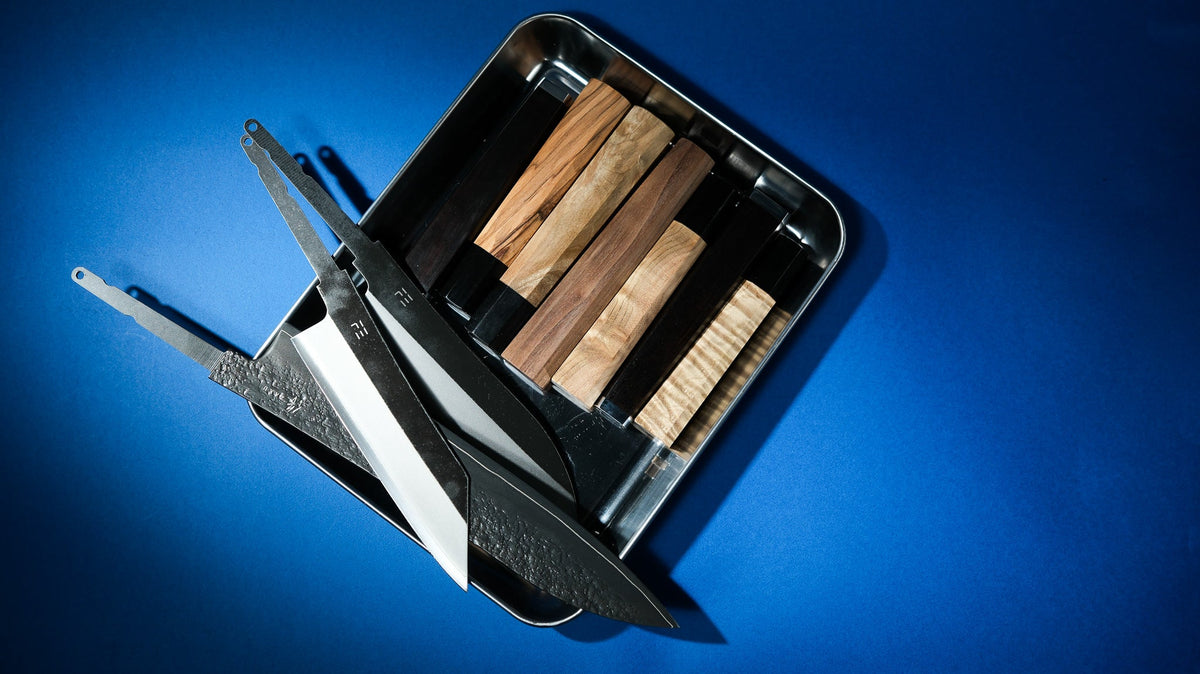
FE stores. If you would rather compare many shapes, sizes, and handles in one place, we have stores in Osaka, Kyoto, and Tokyo. At each one, you can hold the knives and build your own from a blade and a handle. You can also browse what we have available online at feproject.com.
Carrying your knife in Japan
Japanese law prohibits carrying a blade longer than 6 cm in public without a justifiable reason. Police guidance gives two examples: a cook taking a knife to work, and someone who has bought a knife and is taking it home. A freshly bought knife on its way to your hotel or the airport follows the same logic.
The practical approach is simple: keep the knife sealed in the shop’s packaging, together with a receipt.
Getting it home
Knives cannot go in your carry-on bag. On flights from and within Japan, they must go in your checked luggage. Wrap the blade, keep it in its box or sheath, and place it in the middle of your clothes. A saya, a traditional wooden sheath, protects the blade well. Ask whether the shop sells one or can make one for your knife.
The rules that matter most come after you leave Japan. Most countries allow knife imports, but check your own customs rules before you buy. If you have a layover, check whether your bag stays checked through to the end.

The final word
You do not need a collection; one knife in a shape and size you understand is worth more than a bag of knives you feel unsure about.
We hope this guide gave you some useful information and that it helps you choose with confidence and find a knife you will enjoy using. If you take one thing from it, let it be this: start with how you cook, then pick the shape and the handle that fit.
To learn more about FE, start with What is FE? A Knife Built Around Choice.